“Thank you for presenting. It helped me think of ways to utilize within my job!”
Paul
Attendee, ASQ Milwaukee Section
Case study · ASQ Milwaukee Section
Quality and manufacturing professionals in southeast Wisconsin had been handed AI by policy memo. Galina showed them why AI adoption is a process improvement challenge, not a technology rollout, and gave them a plan they could start the next morning without owning the IT budget.
The challenge
Most of the people in this room had already been told how to use AI. Their companies bought a Microsoft Copilot license, sent a policy email, and left them with a blank chat box. Some had been told Copilot was the only tool they were allowed to use.
At the same time, the headlines told them AI would replace their work, and agents would run everything. For people who have spent 20 or 30 years mastering their craft, that isn't a reason to get excited about a new tool.
When Galina prepared with the section's Programs Chair, three questions kept coming up: How can AI actually help us? What do we need to know? And is it going to replace us? The section was also facing a labor shortage as experienced people retired faster than new ones arrived, while the new ISO 9001:2026 standard asked companies to retain and share organizational knowledge.
The approach
Galina built the talk from her Artificial Reality interviews with business owners and operators about how they actually use AI: what's working, what's broken, and what still needs to be built.
According to the U.S. Census Bureau, four in five U.S. businesses still don't use AI to produce their goods or services. This audience wasn't behind. They were early, and they could learn from the people who started first.
AI breaks down where the real steps of the work were never written down. That is exactly where quality professionals are strongest.
The plan
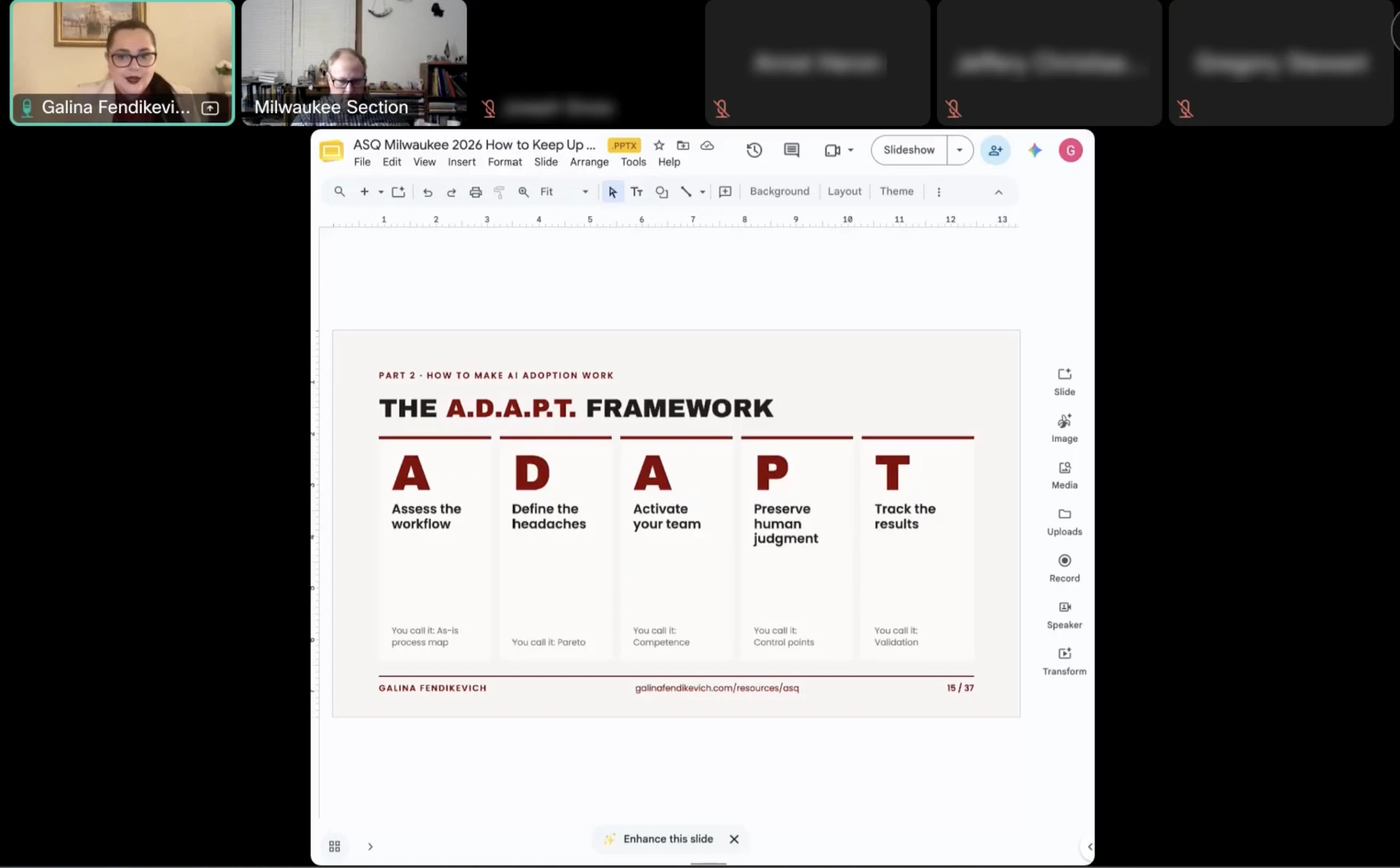
A five-step framework drawn from the businesses where AI actually stuck, translated into the language quality professionals already use.
Galina paired the framework with practical examples of what Microsoft Copilot can do for a quality team: summarize, draft, review and compare, and analyze. Attendees also received a one-page template for bringing requirements to IT and a short list for managers on why a policy is not a plan.
In the chat, attendees named the headaches they would hand off first: checking prints for accuracy, finding the root cause of a laboratory error, converting requirements into test plans, and comparing a customer's new supplier quality manual against last year's.
The audience response
“Thank you for presenting. It helped me think of ways to utilize within my job!”
Attendee, ASQ Milwaukee Section
“Galina, this was an excellent presentation. Thank you so much.”
ASQ Milwaukee Section
“Customers are always updating the supplier quality manual… How are they different? Are there new requirements? … That's my job and I don't like it. So that's one job I could get rid of.”
Programs Chair, ASQ Milwaukee Section
The takeaway
Attendees said the session was informative and that they left with specific ways to use AI in their own jobs. The section's Programs Chair connected the framework to a task from his own career before the call ended, and invited Galina back next year to share what has changed.
The message landed because it started with their expertise, not the technology. No hype, no “one prompt, job done,” just a realistic plan built on the skills this audience already has.
From the session
The two-page ASQ Milwaukee guide has the A.D.A.P.T. framework, practical AI tasks and a one-page request to bring to IT. Enter your email on the ASQ guide page and it's yours.